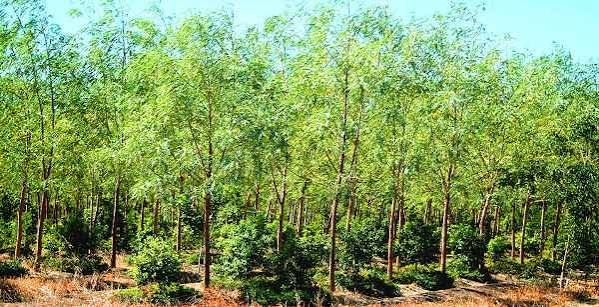
If you’ve read our Mahogany vs Teak comparison or our honest take on Agarwood farming, you’ve probably already come across sandalwood — the tree everyone mentions but almost nobody actually grows correctly. Search “sandalwood farming India” and you’ll find dozens of nursery websites promising ₹1 crore returns from one acre in 12 years. Almost none of them mention that sandalwood is a root parasite that needs a host plant to survive, or that owning a sandalwood tree comes with legal paperwork most farmers never bother to check.
This article covers what actually matters if you’re considering sandalwood on your land in Murshidabad, Birbhum, or anywhere else in West Bengal: whether the climate here even supports it, what it really costs, how long you’re waiting for a payout, and where the genuine risks sit.
What “Sandalwood” Actually Means — Two Very Different Trees
Before anything else, sort out which tree you’re being sold.
Santalum album (Indian White Sandalwood / Chandan) is the real deal — the fragrant heartwood used in perfumery, agarbatti, and religious ceremonies. This is the high-value species, and it is a hemi-parasite: its roots physically attach to a host plant’s roots and draw nutrients from it. Without a host, the sapling dies within a year or two.
Pterocarpus santalinus (Red Sanders / Red Sandalwood) is a completely different tree — no fragrance, valued for its dye and dense red timber, and heavily restricted under Andhra Pradesh forest law because of historic smuggling. If a nursery is vaguely calling something “sandalwood” without specifying the botanical name, ask directly. The two trees have almost nothing in common commercially.
This guide is about Santalum album, the fragrant white sandalwood.
Does West Bengal’s Climate Actually Suit Sandalwood?
This is the part most sales pitches skip. Sandalwood’s traditional native belt is Karnataka, Tamil Nadu, and Andhra Pradesh — semi-arid, red lateritic soil, distinct dry seasons, altitude between 600–1000m in many natural stands.
West Bengal, particularly the Rarh zone (Murshidabad, Birbhum, Bankura, West Medinipur), has some genuine advantages: well-drained lateritic soil, decent groundwater, and warm temperatures most of the year. What works against it is our high humidity and heavy monsoon rainfall — sandalwood does not like waterlogging, and prolonged humid spells increase the risk of spike disease and fungal root issues that are less common in the drier southern plantations.
Practical read: Sandalwood can survive and even grow reasonably in the drier upland pockets of Murshidabad and Birbhum (the same lateritic tracts where Mahogany and Melia Dubia do well), provided drainage is excellent and the field isn’t in a low-lying flood-prone pocket. It is not a crop for waterlogged Ganga-Padma floodplain land. If your plot sits in bottomland that holds water during monsoon, sandalwood is a poor fit — put that land into Melia Dubia or paddy instead, and reserve the higher, well-drained portion of your plot for sandalwood.
The Host Plant Problem Nobody Explains Properly
This is the single most misunderstood part of sandalwood cultivation, and it’s where most first-time growers lose their saplings.
Sandalwood needs a host plant its entire life — first a short-term “primary host” for the first 12–18 months, then a long-term “secondary host” that stays planted alongside it for the full rotation.
Common primary hosts: Cajanus cajan (arhar/tur dal) and Sesbania — fast-growing, cheap, and disposable after the first year or two.
Common long-term secondary hosts: Pongamia (karanj), Casuarina, and various Acacia species. Some growers in South India also use Melia dubia itself as a host — which, if it holds up regionally, is a genuinely useful overlap for anyone already growing Melia Dubia on part of their plantation.
The mistake to avoid: Planting sandalwood alone, or planting it with a host that dies off or gets shaded out within a few years. A sandalwood tree that loses its host stops thriving — growth stalls and heartwood formation, which is the entire point of the crop, slows dramatically. Any nursery or “consultant” who sells you sandalwood saplings without a clear, named host-planting plan is not giving you a viable plantation.
The Legal Side: What Changed and What Hasn’t
For decades, sandalwood cultivation in India was tangled in state-specific felling and transport restrictions, because the tree was historically a government-monopoly species in states like Karnataka. This scared off private growers even when the tree was legally theirs to plant.
The relevant shift: the Karnataka Forest (Amendment) Act, 2001 and later amendments in several states removed sandalwood from the list of “reserved trees” requiring government permission simply to grow it on private land, and later relaxations (national and state-level, continuing through the 2010s) eased the felling and transit permit process for privately grown sandalwood specifically.
What this means practically for a West Bengal grower in 2026:
- Growing sandalwood on your own private agricultural land is legal.
- Felling and transport still require a permit from the state Forest Department — this has not disappeared, only simplified in most states. Rules and paperwork requirements vary by state and can change; verify current West Bengal Forest Department requirements with your local Range Office or DFO before you plant, and again before you fell, since felling is typically 15+ years away and rules may shift in that window.
- Keep documentation from day one: purchase receipt for saplings, a dated planting record with GPS coordinates or plot survey number, and photographs at intervals. When it’s time to fell and sell, this paper trail is what proves the wood was legitimately private-grown, not sourced from a reserve forest.
This isn’t a reason to avoid sandalwood — it’s a reason to treat the compliance step as part of the plantation budget, not an afterthought handled 15 years from now by whoever remembers.
Real Timeline and Cost Expectations
Numbers below are working estimates for planning, not guarantees — heartwood yield in particular varies hugely by soil, host plant health, spacing, and how the tree is managed, so treat this as a planning range, not a promise.
| Stage | Timeline | What Happens |
|---|---|---|
| Nursery to field planting | Month 0 | Grafted or seed-origin saplings, host plant established first |
| Establishment phase | Years 1–5 | Slow visible growth — most of the tree’s early energy goes into root and host-attachment development |
| Heartwood formation begins | Years 8–10 | Fragrant heartwood starts forming at the core; sapwood (outer layer) has no fragrance value |
| Harvest-ready | Years 15–20 | Traditional rotation; some plantation programs claim 12 years is possible with intensive management, but 15+ years is the safer planning assumption |
Cost side (per acre, rough working figures):
- Saplings (roughly 400–500 trees/acre at wider spacing than Mahogany, since sandalwood needs room and host-plant space) plus host plants
- Fencing — non-negotiable, since sandalwood theft during the heartwood-value years is a genuine risk in many growing regions
- Ongoing host-plant maintenance and periodic soil/drainage management for 15+ years
Return side: Heartwood price is quoted per kilogram and varies enormously with quality grade, oil content, and market conditions — figures circulating online range widely and are frequently exaggerated by sapling sellers. Rather than repeating an unverifiable per-tree number here, the honest framing is this: sandalwood is a long-hold, potentially high-value, illiquid asset — closer to planting an inheritance than a cash crop. If your investment horizon is under 15 years, or you need this land to produce income sooner, sandalwood should be a small side-planting, not your main plantation strategy.
Where Sandalwood Fits on a Bengal Timber Plot
For a mixed 5-acre plantation like the model we’ve discussed in our Mahogany vs Teak and Melia Dubia guides, sandalwood makes most sense as a minority planting on your best-drained land, not the whole plot:
- Melia Dubia — fastest cash flow (6–8 years), lowest risk, does the heavy lifting for near-term returns
- Mahogany / Teak — mid-horizon (15–20 years), established markets, moderate risk
- Sandalwood — smallest area, highest theoretical value per tree, longest horizon, highest management and security burden — theft-proofing alone is a real cost most calculators ignore
Treat sandalwood the way you’d treat a long-dated, illiquid investment inside a diversified portfolio: a deliberately small allocation, not the core position.
Common Red Flags When Buying Sandalwood Saplings
- Sellers who won’t name the host plant or provide a written host-planting schedule
- Guaranteed buyback promises at a fixed price 12–15 years out — no legitimate buyer can commit to a price that far in advance, and this is one of the most common patterns in sandalwood investment scams
- No mention of felling/transport permit requirements at all
- Saplings priced far below or far above what comparable grafted Santalum album stock costs elsewhere — both directions are a red flag
- “12-year guaranteed harvest” claims without qualification — possible under ideal, intensively managed conditions, but not the number to plan your finances around
The Honest Bottom Line
Sandalwood can work on the higher, well-drained lateritic tracts of Murshidabad and Birbhum, alongside a properly chosen and maintained host plant, with realistic expectations about a 15–20 year horizon and ongoing compliance paperwork. It is not a quick-return crop, it is not risk-free, and most of the “sandalwood millionaire” claims online skip the host-plant requirement, the permit process, and the theft risk entirely.
If you’re planning a mixed plantation and want a small, long-horizon allocation alongside faster-return species, sandalwood is worth including — planted correctly, on the right part of your land, with paperwork started from day one.
Have questions about fitting sandalwood into your existing plantation plan? Compare it against Mahogany and Melia Dubia in our timber species guide, or drop your plot details in the comments and we’ll help you think through the layout.