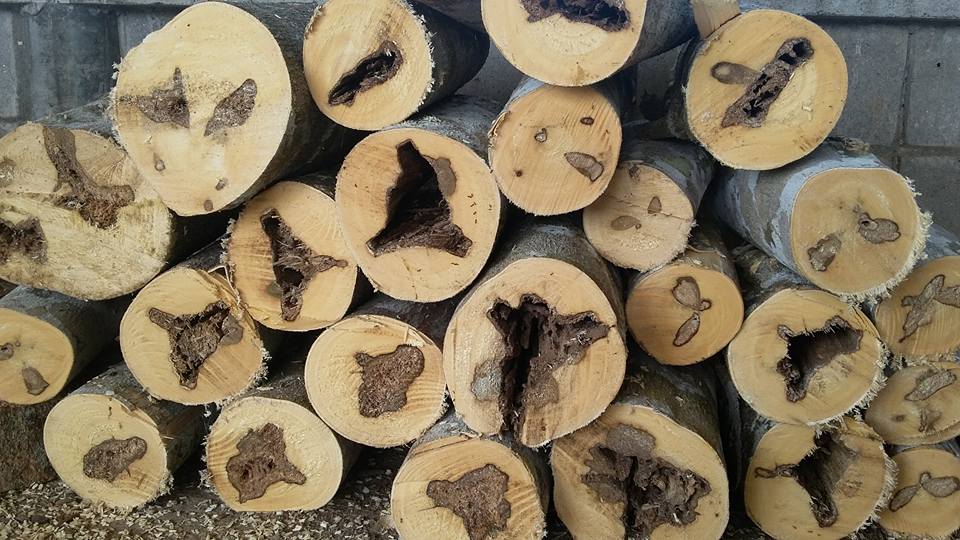
Agarwood — known as Agar in Hindi, Agaru in Sanskrit, and Xashi in Assamese — is often called “liquid gold” and “wood of the gods.” The resinous heartwood of the Aquilaria tree produces one of the most expensive raw materials on earth: top-grade oud oil can fetch over Rs 70 lakh per litre, and premium agarwood chips sell for Rs 50,000 to Rs 5 lakh per kilogram.
With numbers like these circulating on social media, it is no surprise that farmers across Bengal and Northeast India are asking: should I plant Agarwood?
The honest answer is: maybe — but only if you go in with realistic expectations, proper legal permits, and an understanding of the significant risks involved. This article gives you the full picture, not just the dream.
What is Agarwood and why is it valuable?
Agarwood is not the wood of the Aquilaria tree itself. The tree’s natural wood is pale, light, and has no fragrance. Agarwood forms only when the tree becomes infected by a specific type of fungus (primarily Phialophora parasitica). In response to the infection, the tree produces a dark, aromatic resin as a defence mechanism. This resin-saturated heartwood is what we call agarwood.
In nature, this infection happens randomly — perhaps 1 in 10 wild trees develops agarwood, and it can take 50-100 years. That extreme scarcity is what made wild agarwood so precious that it drove the Aquilaria species to the brink of extinction.
Modern plantation farming solves this by using artificial inoculation: deliberately infecting cultivated trees with fungal cultures after 5-7 years of growth. This triggers resin formation within 1-3 years, allowing harvest at 10-15 years.
The global agarwood market is estimated at over USD 8 billion and growing. Major demand comes from the Middle East (oud perfume and incense), East Asia (traditional medicine and incense ceremonies), and increasingly from European luxury perfume houses.
Can Agarwood grow in Bengal?
Yes, with some important caveats. The Aquilaria malaccensis species grows naturally in Assam, Tripura, Meghalaya, Mizoram, Nagaland, Manipur, and Arunachal Pradesh — essentially the entire Northeast. It has also been successfully grown in parts of North Bengal (Jalpaiguri, Darjeeling Terai, Alipurduar) where conditions are similar to the NE climate.
The ideal conditions are:
- Temperature: 20-35°C (Bengal and NE India fit perfectly)
- Rainfall: 1,500-4,000 mm annually (North Bengal and NE get 2,000-3,500 mm)
- Soil: Well-drained sandy loam or red laterite with pH 4.5-6.5 (acidic soils)
- Altitude: Sea level to 750 metres
- Humidity: 77-85% relative humidity
Best locations in Bengal: Jalpaiguri (Mal, Dhupguri blocks), Alipurduar (Falakata, Madarihat), Darjeeling Terai (Kharibari, Naxalbari), and possibly Bankura-Birbhum laterite zone with irrigation support.
Not recommended for: Murshidabad’s alluvial plains (too alkaline, pH above 7), South 24 Parganas (waterlogging), and Nadia (soil chemistry mismatch). If your land is in the Gangetic alluvial zone with alkaline soil, stick with Mahogany or Teak instead.
In Northeast India: Practically every district of Assam (especially Golaghat, Jorhat, Sivasagar, Tinsukia, Nagaon), Tripura, Meghalaya, and Mizoram is suitable. Assam is already India’s agarwood capital with thousands of active plantations.
Planting guide
Species selection
Two Aquilaria species are commonly cultivated in India:
Aquilaria malaccensis — The primary commercial species. Better cold tolerance, suited for North India, Assam, and North Bengal. This is what most NE India plantations grow. Listed under CITES Appendix II (legal to cultivate on private land with permits).
Aquilaria khasiana — Found naturally in the Khasi Hills (Meghalaya). Suited for hilly terrain and southern regions. Less commonly cultivated.
For Bengal and NE India, choose Aquilaria malaccensis.
Spacing and density
The recommended spacing is 12×12 feet (3.6 x 3.6 m), accommodating approximately 300-350 trees per acre. Some intensive plantations use 8×10 feet for 450-500 trees per acre, but wider spacing produces healthier trees with better resin potential.
Planting season
July to September (monsoon season) is ideal. Seedlings should be 60-90 cm tall and 6-8 months old when transplanted from nursery to field.
Pit preparation and planting
Dig pits of 45 x 45 x 45 cm at least 15 days before planting. Fill with a mixture of topsoil, coco-peat (to loosen clay-heavy soil), and 2-3 kg cow dung per pit. Add 20 grams of Furadan to protect against insects. Plant the seedling at the centre, water immediately, and provide shade for the first month if possible.
Sapling cost
Agarwood saplings cost Rs 50-150 per plant depending on source, quality, and quantity. For a 5-acre plantation with 350 trees per acre (1,750 trees), sapling cost is Rs 87,500 to Rs 2,62,500. Buy only from reputed nurseries in Assam or Nagaland with proven track records — the sapling quality directly affects resin production 10 years later.
Maintenance (Years 1-7)
Water regularly during dry months for the first 3 years. Apply organic manure annually. Weed control is important until the canopy closes around Year 4-5. The trees require minimal maintenance compared to other timber species once established.
The inoculation process — the critical step
This is where agarwood farming diverges completely from normal timber farming. Without successful inoculation, your Aquilaria tree produces zero agarwood — just ordinary pale wood worth almost nothing.
When to inoculate
After 5-7 years, when the tree reaches a girth of at least 15 inches (about 38 cm). Inoculating too early produces poor quality resin; too late wastes growing years.
How inoculation works
Using a drill machine, small holes (6-8 mm diameter, 3-5 cm deep) are drilled into the trunk at regular intervals — typically in a spiral pattern around the trunk. A liquid fungal inoculum (containing Phialophora parasitica or similar strains) is injected into each hole using a syringe.
The tree responds to this “wound” by producing resin around the infected area. Over the next 2-3 years, the resin saturates the heartwood, creating agarwood.
Where to get inoculum
This is the hardest part for most farmers. Reliable fungal cultures are available from:
- Rain Forest Research Institute (RFRI), Jorhat, Assam — a government research institute that supplies inoculum and provides training
- North-East Centre for Biological Sciences (NECBS)
- Private suppliers in Assam (Hojai, Nagaon districts) — verify their reputation before purchasing
The quality of inoculum directly determines the quality (and therefore price) of your agarwood. Poor-quality inoculum is the single biggest reason plantation agarwood fetches lower prices than expected.
Cost breakdown: 5 acres over 12 years
| Cost item | Year 1 | Years 2-7 (annual) | Year 7-8 (inoculation) | Years 8-12 (annual) |
|---|---|---|---|---|
| Saplings (1,750 x Rs 100) | Rs 1,75,000 | — | — | — |
| Land preparation & pits | Rs 75,000 | — | — | — |
| Fencing | Rs 50,000 | — | — | — |
| Fertiliser & manure | Rs 15,000 | Rs 12,000 | — | Rs 8,000 |
| Labour (weeding, pruning) | Rs 30,000 | Rs 20,000 | — | Rs 15,000 |
| Irrigation | Rs 25,000 | Rs 15,000 | — | Rs 15,000 |
| Inoculation (drill + inoculum) | — | — | Rs 1,50,000 | — |
| Miscellaneous | Rs 10,000 | Rs 5,000 | — | Rs 5,000 |
| Subtotal | Rs 3,80,000 | Rs 52,000/yr | Rs 1,50,000 | Rs 43,000/yr |
Total investment over 12 years: Rs 8,62,000 (approximately Rs 1.72 lakh per acre)
This is significantly higher than Mahogany (Rs 80,000/acre over 15 years) or Melia Dubia (Rs 76,000/acre over 7 years) due to the expensive saplings and inoculation costs.
Revenue: The realistic picture
Here is where most agarwood articles on the internet mislead readers. Let us be honest about both the potential and the reality.
What is theoretically possible
With 85% survival, your 5-acre plantation will have approximately 1,490 harvestable trees. If each tree produces 4 kg of agarwood (the commonly cited average), and the average price is Rs 50,000 per kg:
- Total agarwood: 1,490 x 4 kg = 5,960 kg
- Revenue: 5,960 x Rs 50,000 = Rs 29.8 crore
This is the kind of number you see on YouTube and social media. It makes agarwood look like an ATM machine.
What actually happens
The reality is significantly different:
Not every tree produces equal resin. Even with artificial inoculation, resin production varies enormously. Some trees produce excellent dark resin (Grade A); many produce lighter, lower-grade resin; some produce almost nothing. Realistic yield: 1-4 kg per tree average, not 4 kg guaranteed.
Quality grades vary by 100x in price. Grade A agarwood chips: Rs 2-5 lakh/kg. Grade B: Rs 50,000-1,00,000/kg. Grade C (most plantation wood): Rs 5,000-30,000/kg. Grade D (used for oil distillation): Rs 1,000-5,000/kg. Most plantation agarwood falls in Grade B-C, not Grade A.
The more realistic calculation:
- Average yield: 2 kg usable agarwood per tree
- Average price (Grade B-C mix): Rs 25,000 per kg
- Trees: 1,490
- Revenue: 1,490 x 2 x Rs 25,000 = Rs 7.45 crore
- Net profit: Rs 7.45 crore – Rs 8.62 lakh = approximately Rs 7.36 crore
Even the conservative estimate is extraordinary — roughly Rs 1.47 crore per acre over 12 years. But keep the risk factors (below) in mind before celebrating.
Legal requirements — do not skip this
Aquilaria malaccensis is listed under CITES Appendix II and is classified as critically endangered. Growing it on private land is legal in India, but you need permits:
For cultivation: Inform your District Forest Officer (DFO) and obtain a No Objection Certificate (NOC) for planting on private land. This is usually straightforward.
For harvesting and transport: You need a Transit Permit from the state forest department before cutting, transporting, or selling any agarwood. Without this permit, possessing agarwood can lead to seizure and prosecution under the Indian Forest Act.
For export: An export permit from the Ministry of Environment, Forest and Climate Change (MoEFCC) is required, along with a CITES Export Permit. This process is bureaucratic and can take months.
State-specific rules: Rules vary by state. Assam has the most established framework for agarwood cultivation permits. West Bengal’s rules are less clear — contact the DFO of your district (Jalpaiguri, Alipurduar, or Darjeeling) before investing.
5 risks most guides will not tell you
1. Inoculation failure
If the inoculum quality is poor or the process is done incorrectly, the tree may not produce any valuable resin. You then have 12 years of investment producing ordinary wood worth Rs 2,000-5,000 per tree instead of Rs 50,000 or more. This is the single biggest risk in agarwood farming.
2. No guaranteed buyer at harvest
Unlike Melia Dubia (which sells to plywood factories in bulk), agarwood has no organised buying market. You need to find traders in Assam’s Hojai-Nagaon belt or Middle Eastern buyers independently. Middlemen take 20-40% margins. Without buyer connections, you may struggle to get a fair price.
3. Theft and security
Agarwood’s extreme value makes plantations a target. In Assam, there have been reported incidents of illegal harvesting from private plantations. If your land is in a remote area, security is a real concern that adds to operational costs.
4. Legal complications
The permit process can be slow and bureaucratic, especially in states where agarwood cultivation is newer (like West Bengal). Transporting agarwood without proper documentation can result in seizure, even if the wood is from your own plantation.
5. Quality is unpredictable
Even with the best inoculum and perfect growing conditions, the quality of resin produced varies tree to tree. You cannot guarantee Grade A production. Most first-generation plantation farmers produce Grade B-C agarwood, which is 5-20x less valuable than Grade A. Managing expectations is critical.
Our honest recommendation
Agarwood farming is not a scam — the returns genuinely can be extraordinary. But it is also not the “guaranteed crores” that YouTube videos promise. It is a high-risk, high-reward investment that requires:
- Land in the right climate zone (NE India or North Bengal Terai)
- Patient capital locked in for 10-15 years
- Access to reliable inoculum suppliers
- Forest department permits before planting
- Connections to the agarwood trading network for selling
If you are a first-time timber investor, start with a lower-risk species like Melia Dubia (7-year cycle, guaranteed industrial buyers) or Mahogany (proven in Bengal). Once you have timber farming experience and cash flow, dedicate 1-2 acres to Agarwood as a high-upside bet alongside your main plantation.
If you are in Assam or NE India with existing farming experience and the right soil conditions, agarwood is a strong choice. Connect with RFRI Jorhat for training and inoculum supply. Start with 1 acre as a trial before scaling up.
Use our free Timber Plantation ROI Calculator to model agarwood returns alongside other species — select “Agarwood” from the species menu and adjust the yield and price assumptions to match your local conditions.
Further reading
If you are seriously considering agarwood, these articles on FarmingBengal.in will help you build a complete picture:
- Mahogany vs Teak: Which Is More Profitable on 5 Acres? — for lower-risk alternatives
- Melia Dubia: Harvest in Just 7 Years — the fastest-return timber option
- Intercropping with Timber Trees — earn while your Agarwood grows
- Top 5 Government Schemes for Bengal Farmers — SMAF subsidies apply to Agarwood
Disclosure: Some links in this article are affiliate links. If you purchase through these links, we earn a small commission at no extra cost to you. This helps keep FarmingBengal.in free and independent.
Published on FarmingBengal.in — Your farming and land investment guide for Bengal Category: Timber Farming | Reading time: 12 minutes