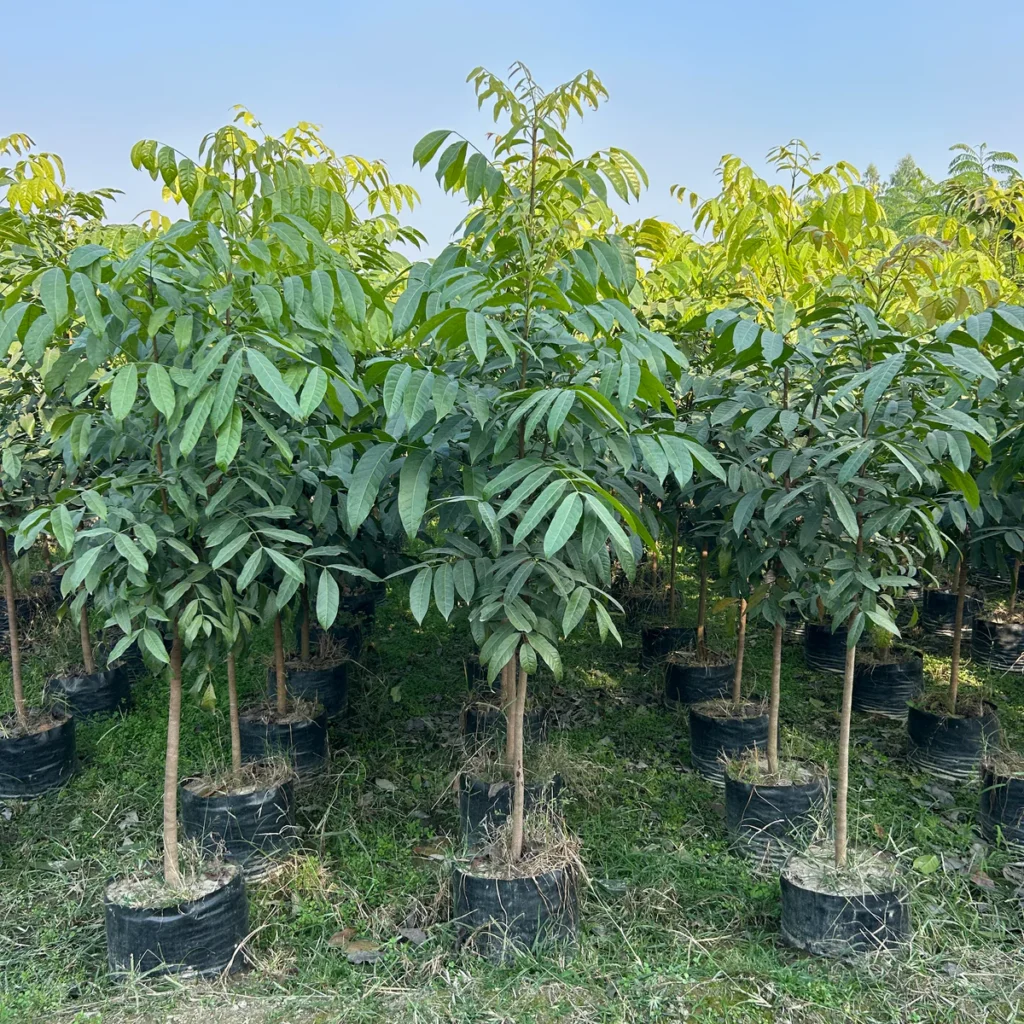
If you own 5 acres of land in Bengal and want to grow timber for long-term income, two species dominate the conversation: Mahogany (Swietenia macrophylla) and Teak (Tectona grandis). Both are high-value hardwoods with strong market demand, but they differ significantly in harvest timeline, upfront costs, climate suitability, and total returns.
In this article, we compare both species head-to-head using real cost data from West Bengal nurseries and current timber market prices, so you can make an informed decision for your land.
What you will need for a 5-acre timber plantation
Before diving into the comparison, here is a quick checklist of essential tools and supplies you will need regardless of which species you choose:
- Saplings — 2,000 Mahogany or Teak saplings (check current availability and prices on Nurserylive)
- Pruning shears — for annual pruning and maintenance; a good bypass pruner lasts 5+ years
- Digital soil pH meter — test your soil before planting; Mahogany needs pH 6.0-7.5, Teak prefers 5.5-7.0
- Drip irrigation starter kit — essential for the first 2-3 years until roots are established
- NPK 10:26:26 fertilizer — applied quarterly in Year 1 for strong root development
- Garden fencing wire mesh — protects young saplings from cattle and goat damage
Investing in quality tools from the start saves money in the long run. A Rs 500 pruner that lasts 5 years is cheaper than buying Rs 150 ones every season.
The basics: Mahogany vs Teak at a glance
Mahogany is a tropical hardwood that thrives in the alluvial and laterite soils of Bengal. It grows faster than Teak in humid conditions, reaching harvestable size in 12-15 years. The wood is prized for furniture and interior work, fetching Rs 2,500-3,200 per cubic foot in wholesale markets.
Teak is the gold standard of Indian timber. It takes 18-25 years to reach full maturity but commands the highest prices: Rs 3,000-4,000 per cubic foot for well-grown logs. Teak is more drought-resistant and does well in the Rarh zone of Bengal, particularly in Bankura, Birbhum, and western Murshidabad.
Cost comparison: 5-acre plantation setup
Let us break down the actual costs for setting up a 5-acre timber plantation with each species in Bengal. These figures are based on 2025-26 nursery prices and typical labour costs in rural West Bengal.
Mahogany setup costs
At 400 trees per acre (20×12 ft spacing), you need 2,000 saplings. At Rs 30-40 per sapling, your planting cost is Rs 60,000-80,000. Add pit digging (Rs 25,000), organic vermicompost at 2-3 kg per pit (Rs 15,000 for 5 acres), fencing wire around the perimeter (Rs 40,000), and first-year maintenance including NPK fertilizer and labour (Rs 60,000 for 5 acres). Total Year 1 cost: approximately Rs 2.0-2.2 lakh.
Teak setup costs
Teak saplings cost Rs 20-30 each. At 400 trees per acre, that is Rs 40,000-60,000 for 2,000 saplings. Other costs — pit digging, vermicompost, fencing, and first-year maintenance — are similar. Total Year 1 cost: approximately Rs 1.8-2.0 lakh. Teak is slightly cheaper to establish.
Ongoing maintenance (both species)
Annual maintenance for both species runs Rs 8,000-12,000 per acre, covering weeding, pest management, and periodic pruning. Invest in a quality pair of bypass pruning shears — you will use them every year for side-branch pruning, which is critical for producing straight, knot-free timber that fetches top prices.
Over the full cycle, your total investment (excluding land) will be Rs 8-10 lakh for Mahogany (15 years) and Rs 10-12 lakh for Teak (20 years).
Pro tip: Before planting, always test your soil with a digital soil pH meter. Mahogany thrives in slightly acidic to neutral soil (pH 6.0-7.5), while Teak does better in well-drained laterite soils (pH 5.5-7.0). If your soil pH is below 5.5, which is common in Bankura and parts of Birbhum, add 200 gm of agricultural lime per pit to correct it. A Rs 400 pH meter can save you from planting the wrong species on unsuitable soil — a mistake that costs lakhs.
Revenue and ROI analysis
Mahogany harvest (Year 15)
With 85% survival, you will have approximately 1,700 trees. At 20-25 cft per tree and Rs 2,800/cft, gross revenue is Rs 95 lakh to Rs 1.19 crore. After deducting total costs of Rs 8-10 lakh, net profit is Rs 85 lakh to Rs 1.09 crore. That is an ROI of roughly 900-1,100% over 15 years, or 16-18% annualized (CAGR).
Teak harvest (Year 20)
With 85% survival and 18-22 cft per tree at Rs 3,500/cft, gross revenue is Rs 1.07-1.31 crore. Net profit after Rs 10-12 lakh in costs: Rs 95 lakh to Rs 1.19 crore. ROI is 800-1,000% over 20 years, or 12-14% annualized.
The key insight
Mahogany delivers comparable total profit 5 years earlier. On an annualized basis, Mahogany wins with 16-18% CAGR versus Teak at 12-14%. However, Teak commands higher per-unit timber prices and is more resistant to market fluctuations.
Want to run these numbers for your exact land size and local prices? Use our free Timber Plantation ROI Calculator — it covers both species with year-by-year cash flow projections.
Which blocks in Bengal are best for each species?
Best for Mahogany
Kandi, Khargram, Burwan, and Nabagram blocks in Murshidabad (alluvial soil, good moisture); Bolpur and Dubrajpur in Birbhum; English Bazar and Manikchak in Malda. Mahogany needs well-drained soil with moderate to high moisture. Avoid waterlogged Bagri zone areas.
Before finalising your plot, use a 50-metre measuring tape to verify the actual area matches what the seller claims. You would be surprised how often “5 acres” turns out to be 4.2 acres. For larger plots, a GPS area measurement device gives even more accurate readings.
Best for Teak
Suri, Rampurhat, and Nalhati in Birbhum (laterite/red soil); Bankura Sadar, Bishnupur, and Onda in Bankura; Sagardighi in Murshidabad. Teak tolerates drier, well-drained laterite soils better than Mahogany.
The smart strategy: Plant both
For a 5-acre plot, the optimal approach is to allocate 60% to Mahogany (3 acres, 1,200 trees) and 40% to Teak (2 acres, 800 trees). This gives you Mahogany income at Year 15 while your Teak continues growing to peak value at Year 20. You also get thinning income from both species around Year 7-8.
Add intercropping for immediate income
In the first 3-4 years while the canopy is still open, plant turmeric, ginger, or seasonal vegetables between the rows. This generates Rs 30,000-50,000 per acre annually and offsets your maintenance costs — making the plantation practically self-financing from Year 1.
For a complete guide on profitable intercropping combinations, read our article: Intercropping with Timber Trees: Earn Rs 30,000-50,000/Acre
Set up proper irrigation
Both Mahogany and Teak need supplemental watering during the dry season (November-May) for the first 2-3 years. A drip irrigation starter kit is the most water-efficient and labour-saving option. A basic kit for 1 acre costs Rs 3,000-5,000 on Amazon and pays for itself within a single season by reducing manual watering labour costs.
Government subsidies: Get 50% back on saplings
The Sub-Mission on Agroforestry (SMAF) provides up to 50% subsidy on sapling costs. For a 5-acre Mahogany plantation, that means recovering Rs 30,000-40,000 of your Year 1 investment. Apply through your district ADO office or DFO office.
For details on SMAF and other government schemes, read: Top 5 Government Schemes for Bengal Farmers in 2026
Bottom line
Both Mahogany and Teak are excellent choices for Bengal. Mahogany gives faster returns and higher annualized ROI. Teak gives the highest per-unit price and better drought tolerance. For most 5-acre landowners in the Rarh zone, a 60-40 Mahogany-Teak mix is the most balanced strategy. Start with Mahogany if you want income sooner, or Teak if your soil is laterite and you can wait longer.
If you want even faster returns, consider adding Melia Dubia to your mix — it harvests in just 7-8 years. Read our full guide: Melia Dubia: The Fastest-Return Timber Tree for Bengal
Recommended reading
Want to deepen your knowledge of timber farming? These books are excellent investments:
- Agroforestry: Theory and Practice by A.K. Dhyani — the definitive Indian textbook on integrating trees with crops
- Tropical Timber Trees by M.S. Swaminathan — covers species selection, silviculture, and market dynamics
- West Bengal Land Laws by H.K. Saharay — essential if you are buying land for plantation
Disclosure: Some links in this article are affiliate links. If you purchase through these links, we earn a small commission at no extra cost to you. This helps us keep FarmingBengal.in free and independent.
Published on FarmingBengal.in — Your farming and land investment guide for Bengal Category: Timber Farming | Reading time: 10 minutes