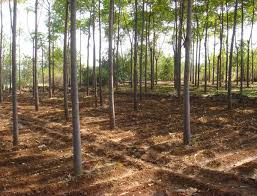
If you want timber income but cannot wait 15-20 years for Mahogany or Teak to mature, there is one species that changes the equation entirely: Melia Dubia, commonly known as Malabar Neem or Forest Neem.
This fast-growing deciduous tree can be harvested in just 7-8 years, produces wood that is in massive demand from India’s plywood, paper, and panel board industries, and thrives in Bengal’s climate. It is arguably the best entry point for first-time timber investors who want to see returns within a single decade.
Here is everything you need to know about growing Melia Dubia in Bengal — from planting to profit.
What makes Melia Dubia special?
Melia Dubia belongs to the Meliaceae family (the same family as Mahogany and Neem) and is native to India. It is considered one of the fastest-growing timber trees in the world. Under good conditions with irrigation, a Melia Dubia tree can grow 40 feet tall in just 3 years and reach a girth of 36 inches by Year 7-8.
The wood is naturally termite-resistant and has a straight, cylindrical trunk with few branches in the lower portion — ideal characteristics for veneer peeling and plywood manufacturing. India’s plywood industry has increasingly adopted Melia Dubia as a domestic alternative to expensive imported timber from Myanmar and Indonesia.
The key advantages over other timber species:
- Speed: Harvestable in 7-8 years (vs 15 for Mahogany, 20 for Teak)
- Market demand: Plywood, paper pulp, MDF, particle board, matchsticks, packing — multiple industrial buyers
- Low maintenance: Pest-resistant, drought-tolerant once established
- Agroforestry fit: Approved under the Sub-Mission on Agroforestry (SMAF) for subsidies
- Bengal suitability: Grows naturally in the Dooars of North Bengal, Assam, and the entire Eastern Indian humid zone
Is Bengal’s climate right for Melia Dubia?
Absolutely. Melia Dubia thrives in tropical moist environments with 500-1,500 mm annual rainfall and temperatures between 15-40°C. Bengal’s Gangetic plain, Rarh zone, and Terai region all meet these requirements comfortably.
The ideal soil is well-drained sandy loam or alluvial soil with a pH of 5.5-8.0. Waterlogging is the one condition Melia Dubia cannot tolerate — if your plot is in a flood-prone Bagri zone area of Murshidabad or the low-lying Sundarbans, you will need raised bed planting or should choose a different species.
Best districts for Melia Dubia in Bengal: Birbhum (Bolpur, Suri, Dubrajpur), Bankura (all blocks), Murshidabad Rarh zone (Kandi, Khargram, Burwan, Sagardighi), Hooghly (Arambag, Pursurah), Malda (Gazole, Habibpur), and Jalpaiguri Terai (Mal, Dhupguri).
Planting guide: Step by step
Spacing and density
The recommended spacing for timber-grade Melia Dubia is 12×12 feet (3.6 x 3.6 metres), which accommodates approximately 300 trees per acre. Some farmers use 10×10 feet (400 trees/acre) for pulpwood harvesting at 4-5 years, but for higher-value plywood-grade timber, wider spacing produces thicker trunks.
For a 5-acre plantation, you will plant 1,500 trees at 12×12 spacing.
Planting season
The best time to plant in Bengal is June-July, coinciding with the onset of monsoon. This gives saplings 4-5 months of natural rainfall for root establishment before the dry season.
Pit preparation
Dig pits of 1.5 x 1.5 x 1.5 feet (45 x 45 x 45 cm) at least 15 days before planting. Mix the excavated soil with 2-3 kg of well-decomposed farmyard manure (FYM) or vermicompost per pit. If your soil is acidic (pH below 6), add 200 gm of agricultural lime per pit.
Sapling selection
Purchase saplings from a reputed nursery — preferably tissue-cultured or clonal saplings which give more uniform growth. Sapling cost ranges from Rs 10-20 per plant depending on source and quantity. For 1,500 saplings (5 acres), budget Rs 15,000-30,000.
First-year care
Water every 7-10 days during the dry season (November-May) for the first two years. Apply 50 gm of NPK (10:26:26) per tree at 3-month intervals during the first year. Weeding is critical — keep a 3-foot radius around each sapling clear of weeds for the first 2 years.
Cost breakdown: 5 acres of Melia Dubia
Here is a realistic cost estimate based on current Bengal prices:
Year 1 (establishment):
- Saplings (1,500 x Rs 15 avg): Rs 22,500
- Pit digging and planting labour: Rs 25,000
- Organic manure/compost: Rs 15,000
- Fencing (if needed): Rs 40,000
- Fertiliser (NPK): Rs 10,000
- Irrigation setup (if no canal): Rs 20,000
- Miscellaneous: Rs 10,000
- Year 1 total: Rs 1.4-1.5 lakh
Years 2-7 (annual maintenance per year):
- Weeding and pruning labour: Rs 15,000
- Fertiliser: Rs 10,000
- Irrigation costs: Rs 10,000
- Pest management: Rs 5,000
- Annual maintenance: Rs 40,000 (Rs 8,000/acre)
- 6 years x Rs 40,000 = Rs 2.4 lakh
Total investment over 7 years: Rs 3.8-4.0 lakh (approximately Rs 76,000-80,000 per acre)
Revenue and profit analysis
Yield at Year 7-8
With proper management and 85% survival rate, your 5-acre plot will have approximately 1,275 harvestable trees. At 12×12 spacing with good irrigation, each tree should weigh 500-800 kg and yield 10-15 cubic feet of timber.
Conservative estimate (500 kg/tree):
- Total biomass: 1,275 x 500 kg = 637 tonnes
- Farm-gate price: Rs 5,000-7,000 per tonne
- Gross revenue: Rs 31.9 – 44.6 lakh
Optimistic estimate (700 kg/tree, well-managed):
- Total biomass: 1,275 x 700 kg = 892 tonnes
- At Rs 6,000/tonne: Rs 53.6 lakh
Profit calculation (conservative):
- Gross revenue: Rs 32-45 lakh
- Total investment: Rs 4 lakh
- Net profit: Rs 28-41 lakh (Rs 5.6-8.2 lakh per acre)
- ROI: 700-1,000% over 7 years
- Annualized return (CAGR): 34-40%
This makes Melia Dubia significantly more capital-efficient than Mahogany (16-18% CAGR) or Teak (12-14% CAGR), though the per-unit timber price is lower.
Who buys Melia Dubia wood?
Unlike Teak or Mahogany where you sell individual logs to timber merchants, Melia Dubia is typically sold in bulk to industrial buyers. The main market segments are:
Plywood and veneer industry: This is the highest-value market. Plywood factories buy logs with a minimum girth of 25-36 inches at Rs 8,000-11,000 per tonne (factory-gate price). Major buyers include Century Ply, Greenply, and dozens of regional plywood units in West Bengal and Assam.
Paper and pulp industry: Younger trees (4-5 years) or smaller-diameter logs are sold as pulpwood at Rs 3,500-5,000 per tonne. Companies like Seshasai Paper and ITC are active buyers.
MDF and particle board: Medium-density fibreboard factories accept Melia Dubia at Rs 4,000-6,000 per tonne. This market is growing rapidly in India.
Tip: For best prices, grow to Year 7-8 until trees achieve 30+ inch girth. Selling too early (at Year 4-5) means you get only pulpwood prices, which are 40-50% lower than plywood-grade prices. Patience pays.
Melia Dubia vs Mahogany vs Teak: Which should you choose?
The answer depends on your timeline and financial goals:
Choose Melia Dubia if: You want the fastest returns (7-8 years), have irrigated land, and are comfortable selling to industrial buyers in bulk. Best for investors who want a quick cycle and plan to replant for a second rotation.
Choose Mahogany if: You can wait 12-15 years, want higher per-unit timber value, and plan to sell individual logs to furniture or construction markets. Best for long-term wealth building.
Choose Teak if: You have laterite or well-drained upland soil, can wait 18-20 years, and want the highest price per cubic foot. Best for premium timber investors.
The smartest approach: Combine all three. Plant Melia Dubia on 2 acres for quick returns, Mahogany on 2 acres for medium-term income, and Teak on 1 acre for the highest long-term value. The Melia Dubia harvest at Year 7-8 funds your ongoing maintenance costs for the slower-growing species.
Government subsidy: Get 50% back on saplings
The Sub-Mission on Agroforestry (SMAF) covers Melia Dubia as an approved species. You can claim up to 50% subsidy on sapling costs and up to Rs 25,000 per hectare for plantation establishment. Apply through your district ADO office or DFO office. Your local KVK can help with the application process.
For a 5-acre plantation, this subsidy can recover Rs 15,000-25,000 of your Year 1 investment — a meaningful reduction in risk.
Bottom line
Melia Dubia is the fastest path from plantation to profit in Bengal. A Rs 4 lakh investment on 5 acres can return Rs 28-40+ lakh in just 7-8 years — a CAGR of 34-40% that outperforms almost any other agricultural or financial investment. The wood has guaranteed industrial demand, the species grows naturally in Bengal’s climate, and government subsidies are available to reduce your upfront costs.
If you are new to timber farming and want to test the waters before committing to a 15-20 year species, Melia Dubia is your ideal starting point.
Calculate your exact returns using our free Timber Plantation ROI Calculator — select “Melia Dubia” from the species menu and adjust for your land size and local prices.
Published on FarmingBengal.in — Your farming and land investment guide for Bengal Category: Timber Farming | Reading time: 10 minutes