You’ve done the hard part — you bought the land, checked the Khatian, chose your species, and waited out seven, ten, or fifteen years of growth. Then comes the question most plantation guides skip entirely: can you actually cut down your own trees and sell the timber without breaking the law?
The short answer is: usually yes, but not automatically, and not without paperwork. Growing a tree on your own patta land does not by itself give you an unrestricted right to fell it and move it to market. In West Bengal, two separate permissions can come into play — one to fell the tree, and a second, different one to transport it once it’s cut. Missing either can mean your timber sits in a stacked pile with no legal buyer willing to touch it.
The Two Permissions You Need to Understand
1. Permission to Fell — West Bengal Trees (Protection and Conservation in Non-Forest Areas) Act, 2006
This Act governs tree felling on non-forest land across West Bengal — which covers the overwhelming majority of plantation and agricultural land in the state. Under the Act, a “competent authority” (typically the local land and land reforms officer or an officer notified for this purpose) must grant written permission before you fell a tree, based on:
- Proof of ownership or lease of the land where the tree stands
- An inquiry into the application
- Confirmation that felling won’t change the character or use of the land
That last point matters more than it sounds. If felling a large number of trees at once would effectively convert your plantation land into bare land for a different use, the authority can require you to first obtain a land conversion certificate under Section 4C of the West Bengal Land Reforms Act, 1955 before it will grant felling permission. This is the same Section 4C referenced in land-conversion applications on Banglarbhumi — it’s worth checking your land’s classification before harvest planning, not after.
The Darjeeling exception: if your land falls in the Sadar, Kalimpong, or Kurseong sub-divisions of Darjeeling district, you don’t need separate permission under the 2006 Act — permission under Section 4A of the West Bengal Land Reforms Act is sufficient on its own. This matters if your holdings span both a Rarh-zone plot and a hill-district plot, since the process genuinely differs by location.
The replanting obligation: the Act requires that anyone who fells a tree must replant an equivalent number of trees on the same plot and maintain that new plantation for a prescribed period. Build this into your harvest planning from year one — it’s a legal condition of felling, not an optional best practice.
2. Permission to Transport — Transit Permit
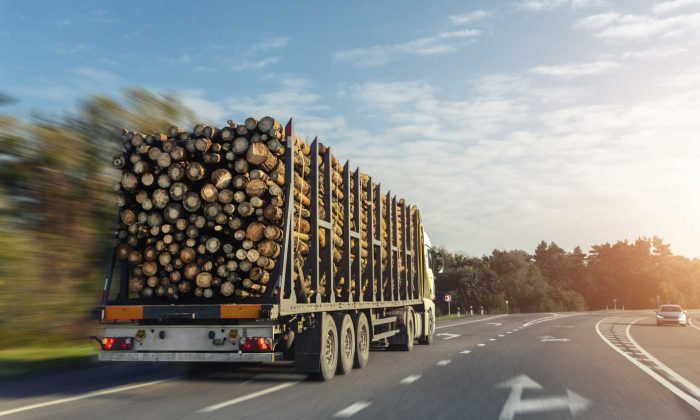
Felling permission and transport permission are not the same thing, and this is where plantation owners most often get caught out. Even timber legally felled from your own land generally needs a Transit Permit from the local Forest Range Office before it can be moved off your property to a sawmill, depot, or buyer. Without it, a truck carrying your logs can be stopped and seized en route, regardless of how clean your ownership paperwork is.
The Ministry of Environment, Forest and Climate Change issued Model Guidelines in November 2014 asking states to exempt certain fast-growing agroforestry species — species like Eucalyptus, Poplar, Casuarina, Subabul, and Melia Dubia (Malabar Neem) were specifically named — from felling and transit restrictions on private land, precisely because these permit requirements were discouraging farmers from planting trees in the first place. Several states have since notified their own exemption lists.
This is the one area where I won’t give you a fixed list — exemption notifications are issued and updated at the state level, and giving you a specific list here risks being wrong by the time you read it. Before harvest, confirm directly with your local Forest Range Officer or Divisional Forest Officer (DFO) whether your specific species and district currently qualify for any transit exemption. A single phone call before felling saves months of dispute after.
Species-by-Species Practical Notes
Since FarmingBengal has covered all five of these species individually, here’s how the permit picture specifically affects each:
- Melia Dubia — named explicitly in the Centre’s 2014 liberalisation push as a fast-rotation species intended for easier felling/transit treatment. Still confirm current status with your local Range Office before your 7-year harvest.
- Teak and Mahogany — high-value timber species that the Centre’s guidelines flagged for a “regulated but more open” environment rather than full exemption. Expect to go through the standard felling-permission process; budget the time for it into your harvest schedule.
- Sandalwood — historically one of the most tightly regulated timber species in India, with several states (notably Karnataka, Kerala, Tamil Nadu) treating it as a government-monopoly species even on private land, before liberalisation reforms eased this in some states. If Sandalwood is part of your plantation, treat this as the species requiring the most careful, well-documented pre-harvest consultation with your DFO — don’t assume the general private-plantation rules automatically apply without checking.
- Agarwood (Aquilaria) — in addition to any state felling/transit rules, Agarwood is listed under CITES Appendix II, meaning international trade in Agarwood and its derivatives is regulated at the national/international level, not just the state level. If you intend to sell into export markets, factor in CITES-related documentation well before harvest, separate from your state transit permit.
A Practical Pre-Harvest Checklist
- Confirm land classification and Khatian status — verify your plot’s classification hasn’t changed and there’s no pending mutation or conversion issue that would complicate a felling application.
- Apply for felling permission early — through the competent authority under the 2006 Act (or Section 4A if in the Darjeeling exception zone), well before your planned harvest date. Inquiries take time.
- Check current transit-exemption status for your species and district directly with the local Range Office — don’t rely on general online lists, which may be outdated for your specific location.
- Plan your replanting obligation into your budget and land-use plan from the start, not as an afterthought.
- For Sandalwood and Agarwood specifically, build in extra lead time for verification and, for Agarwood destined for export, CITES-related compliance.
- Keep every document — ownership proof, felling permission order, transit permit — with the actual timber until it reaches the buyer. A clean paper trail is what actually makes your harvest sellable.
The Bottom Line
None of this should discourage you from timber plantation as an investment — it remains one of the more attractive long-horizon land uses available in Bengal. But the return on that investment depends on being able to legally harvest and sell what you’ve grown, not just on species selection and ROI projections. Build the permission timeline into your plantation plan at the same stage you plan your species mix and spacing, and confirm the specifics with your local Forest Range Office — rules and exemption lists do get updated, and a five-minute conversation before felling is far cheaper than a dispute after.
This article explains the general legal framework and is not a substitute for confirming current, location-specific rules with your local Forest Range Office or Divisional Forest Officer before any felling or transport activity.